Global outlook
The World Just Set Another Emissions Record — Here's What 2025's Numbers Really Mean
Fossil fuel CO2 emissions hit a new high in 2025 even as clean energy expanded, and the remaining carbon budget for 1.5°C is now down to about four years at current rates.
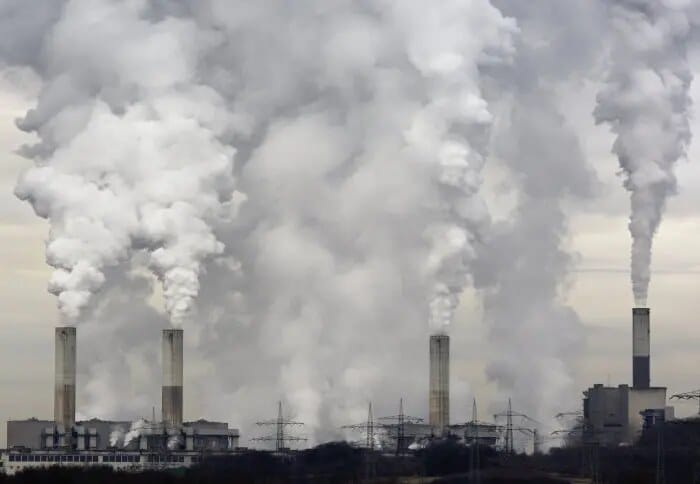
The 2025 Global Carbon Budget, produced by an international consortium of climate scientists, put global fossil fuel CO2 emissions at approximately 38.1 billion tonnes for the year - a new record, up 1.1 percent from 2024.[1] Every major fossil fuel category contributed to the rise: coal emissions grew 0.8 percent, oil 1.0 percent, and natural gas 1.3 percent.[1] Including emissions from land-use change, total global CO2 emissions came in at roughly 42.2 billion tonnes - marginally lower than 2024, a reminder that the land-use component of the global carbon ledger can move independently of, and sometimes mask, the underlying trend in fossil emissions.[1]
A mixed picture by country
The country-level breakdown complicates any simple narrative about who is driving the increase. China's emissions growth slowed to just 0.4 percent, a deceleration credited to the country's rapid build-out of renewable energy capacity.[1] India's growth also decelerated, to 1.4 percent, alongside declining growth in coal consumption.[1] The United States saw emissions rise 1.9 percent and the European Union 0.4 percent, while Japan recorded a 2.2 percent decline - the first year Japan's trajectory was highlighted as a bright spot in this dataset.[1] Two sectors stood out for the wrong reasons: international aviation emissions jumped 6.8 percent as global air travel continued its post-pandemic rebound, while international shipping emissions held roughly flat.[1]
The sink that is starting to strain
Earth's land and ocean carbon sinks - the natural systems that have been quietly absorbing roughly half of all human-caused CO2 emissions for decades - recovered to pre-El Niño levels in 2025, after weakening noticeably during the severe El Niño of 2023–24. But researchers caution that, over the longer term, climate change itself is reducing the combined capacity of the land and ocean sinks to keep absorbing carbon at historical rates.[1]
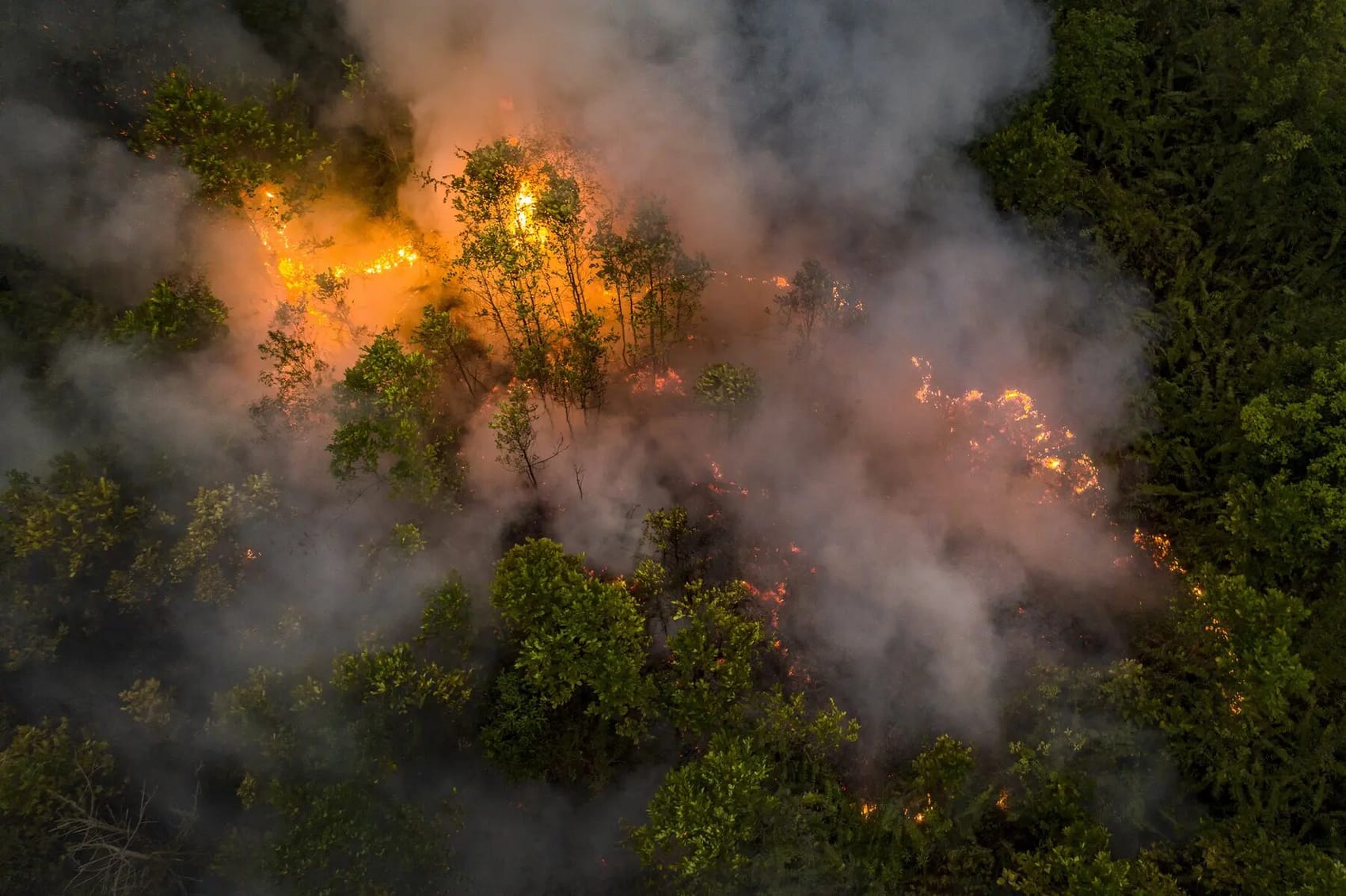
Most concerning within that finding: tropical forests in Southeast Asia and South America have been identified as regions where forests can shift from being net absorbers of carbon to net sources, particularly during severe drought and fire years.[1] Indonesia's record-breaking 2026 fire season - concentrated heavily in carbon-dense peatland regions of Sumatra and Kalimantan - is exactly the kind of event that can push a regional forest carbon balance from the sink side of the ledger to the source side, even if only temporarily.
Four years, at current rates
Perhaps the single most consequential number in the 2025 report is the size of the remaining carbon budget consistent with a 50 percent chance of keeping global warming below 1.5°C: approximately 170 billion tonnes of CO2.[1] At 2025's emissions rate, that budget would be exhausted in roughly four years - a timeline the report's authors describe, without much room for interpretation, as "virtually exhausted."[1]
Why the sink matters as much as the source
Public attention to the climate crisis tends to focus almost entirely on emissions - how much fossil fuel is being burned, and how fast that number is rising or falling. The 2025 data is a reminder that the other half of the equation, the planet's capacity to absorb what humanity emits, is not a fixed constant that can be taken for granted. It is itself a variable, sensitive to exactly the kind of pressure that drought, fire and land conversion put on tropical forests and peatlands. Every hectare of intact, high-carbon-density forest or peat swamp that stays standing and undrained is not simply "not adding" to emissions - it is actively performing a service, part of the roughly half of annual human emissions that natural sinks currently absorb, that gets measurably harder to replace once lost.
That is the throughline connecting a record global emissions year to a record Indonesian fire season, and to the case for scaling high-integrity nature-based carbon projects: the remaining carbon budget is a function of both what the world stops emitting and what it manages to keep in the ground - or, in the case of a peat swamp, in the ground and underwater.
Sources
1. Fossil fuel CO2 emissions hit record high in 2025 - Global Carbon Budget
2. CO2 Emissions - Global Energy Review 2025 - International Energy Agency
3. Analysis: Fossil-fuel CO2 emissions to set new record in 2025, as land sink 'recovers' - Carbon Brief